
Car Accident Claims in New York: A Complete Guide
Written by: Timothy Cellino, Licensed Personal Injury Attorney | Cellino Law
Bar Admissions: New York (2018) | Massachusetts (2017)
Education: J.D., Suffolk University Law School (2017) | B.A., John Carroll University
Recognition: Super Lawyers Rising Star, 2022–2025
Attorney Profile: cellinolaw.com/attorneys/timothy-cellino/
Reviewed by: Cellino Law Licensed Attorney Team | cellinolaw.com/attorneys/
Published: 06/06/2026
Last Updated: 06/06/2026
Key Takeaways
The Insurance Research Council found that represented claimants receive 3.5x more compensation than those without attorneys.
- New York is a no-fault state. Your own insurer pays first, up to $50,000 regardless of who caused the accident.
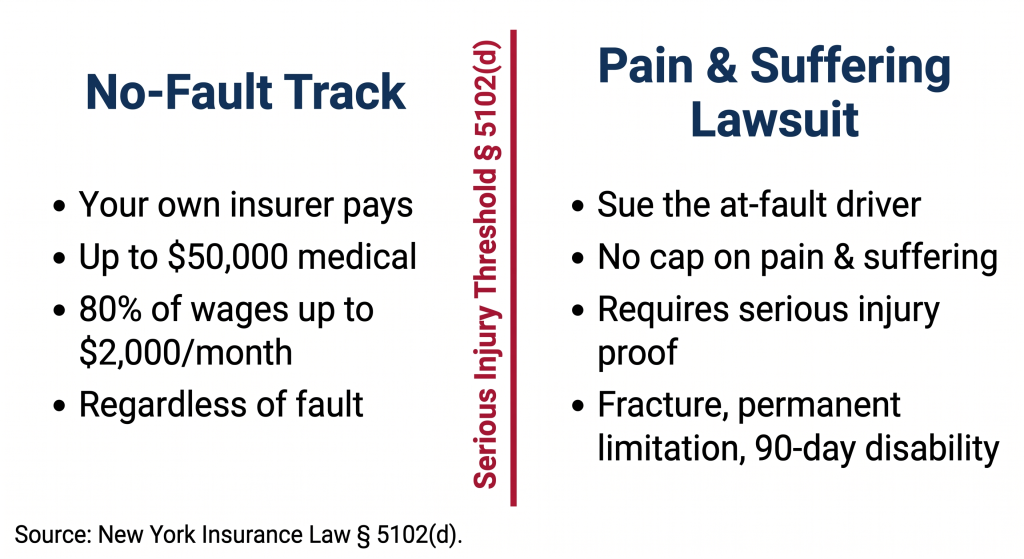
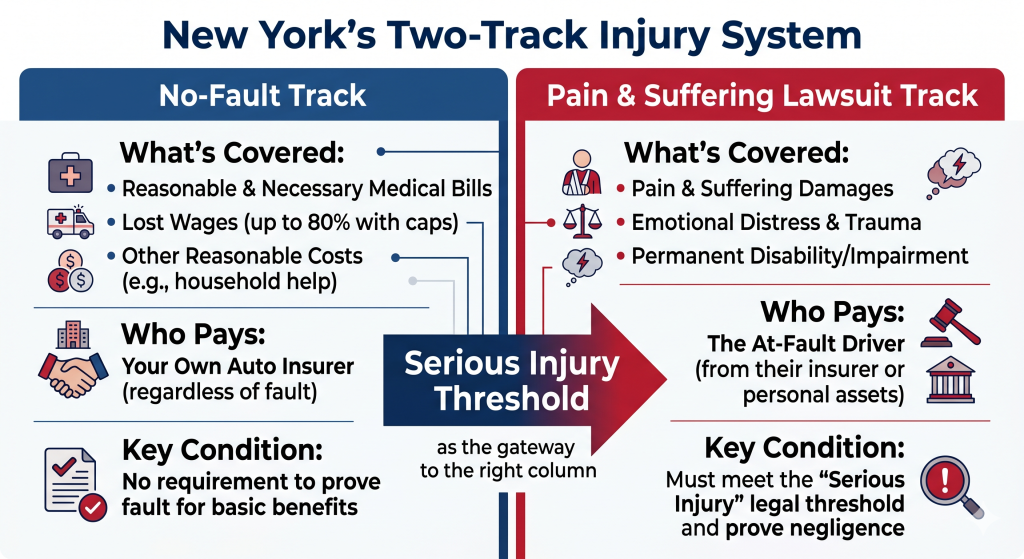
- To sue for pain and suffering, your injuries must clear the “serious injury” threshold under Insurance Law § 5102(d).
- You generally have 3 years to file, but only 90 days if a government vehicle or road defect was involved.
- New York’s pure comparative negligence rule means you can recover even if you were partly at fault.
- There is no statutory cap on pain and suffering damages in New York.
- According to TRIP and NHTSA data, fatal and serious crashes in New York generated $135.4 billion in societal harm in 2023.
I’ve been handling car accident cases in New York since 2018 and in Massachusetts since 2017. Personal injury law is not something I stumbled into, my father Ross, my grandfather, and my mother all practiced it before me. I started law school already knowing how insurance companies think, and I’ve spent my career using that knowledge on the other side of the table.
The numbers behind what happens on New York roads make the stakes clear. According to a 2024 report by TRIP, a national transportation research group, fatal and serious traffic crashes in New York in 2023 generated $135.4 billion in total societal harm, including $33.6 billion in direct economic costs. The New York State Department of Health reports that traffic crashes generate an average of 136,900 emergency department visits and over 12,000 hospitalizations in the state each year, with combined hospital charges averaging $1.1 billion annually.
What follows is not a general overview. It’s the information I wish every client had before they called me, how the no-fault system actually works, when you can and can’t sue for pain and suffering, what damages are available, and what separates cases that recover full value from cases that don’t. Our licensed attorneys across Cellino Law’s offices are available to discuss your specific situation at no cost.
Injured in a New York car accident? Call Cellino Law at +17166705761. I’ll review your case personally, and our licensed team is ready to help. No fee unless we win.
How New York’s No-Fault Insurance System Works
New York has been a mandatory no-fault state since 1974. When I explain this to clients for the first time, confusion is almost always the first reaction, because it doesn’t function the way most people expect insurance to work.
Your own insurance company pays your initial medical bills and a portion of your lost wages after an accident, regardless of who was at fault. In exchange, the law limits when you can sue the other driver for pain and suffering. That’s the trade-off built into the system.
New York’s $50,000 Basic Economic Loss minimum is among the highest no-fault limits in the country, Florida’s mandatory PIP minimum is $10,000, for comparison. But I’ve watched $50,000 disappear quickly in cases involving surgery, extended rehab, or long-term specialist care.
What No-Fault Covers
- Medical expenses: 100% of bills up to the $50,000 BEL limit
- Lost wages: 80% of gross income, capped at $2,000 per month, for up to three years
- Reasonable out-of-pocket costs tied to the injury, such as transportation to appointments
What No-Fault Does Not Cover
- Pain and suffering, this requires a separate lawsuit against the at-fault driver
- Lost wages above the $2,000 monthly cap
- Vehicle repair or replacement (handled through property damage coverage)
- Future medical expenses beyond three years
The 30-Day and 45-Day Filing Rules
You must seek medical treatment within 30 days of the accident to preserve your no-fault benefits. Your treating providers must submit bills to the carrier within 45 days of service. The missed 30-day deadline is the most common technical reason carriers deny legitimate no-fault claims. I handle the no-fault application process on every case I take — because missing it hands the insurer a technical basis to deny a claim that has nothing to do with the merit of your injuries.
No-Fault at a Glance
- Your own insurer pays first regardless of fault
- Up to $50,000 for medical bills; 80% of wages up to $2,000/month
- You have 30 days to begin treatment or risk benefit denial
- No-fault does NOT cover pain and suffering that requires a lawsuit
We handle no-fault paperwork from day one on every case we take. Call +17166705761 so nothing gets missed.
The Serious Injury Threshold: When You Can Sue for Pain and Suffering
This is the most important legal concept in any New York car accident case, and the one I spend the most time explaining to new clients because most people have never heard of it before their accident.
To bring a personal injury lawsuit against the at-fault driver for non-economic damages, pain and suffering, emotional distress, loss of enjoyment of life, your injuries must meet the “serious injury” threshold defined in Insurance Law § 5102(d). According to the New York State Department of Health, motor vehicle collisions generate over 130,000 emergency department visits in New York each year. Not all of those injuries qualify under the statute. Whether yours does — and how that argument is documented and presented, often determines the difference between a $50,000 outcome and a $500,000 verdict.
Categories That Qualify Under § 5102(d)
- Death
- Significant disfigurement
- Fracture
- Loss of a fetus
- Permanent loss of use of a body organ, member, function, or system
- Permanent consequential limitation of use of a body organ or member
- Significant limitation of use of a body function or system
- Medically determined injury preventing substantially all normal daily activities for 90 of the 180 days following the accident
What Courts Actually Look At
Subjective pain complaints alone aren’t enough. Courts require objective medical evidence: MRI findings, range-of-motion measurements, EMG results, specialist opinions. The most consistent defense strategy I see is attacking gaps in treatment, any unexplained break in medical care after the accident. I build every case I take with continuous, well-documented treatment records specifically to defeat that argument. For a full breakdown of how courts apply this standard, see our guide on New York’s serious injury threshold.
Threshold Summary
- Fractures almost always qualify
- Soft tissue injuries require strong objective medical documentation
- Unexplained treatment gaps are the defense’s most common weapon
- I assess threshold on every case I take — free consultation
What Damages Are Available
Economic Damages
Economic damages compensate for verifiable financial losses. I document these with medical records, billing statements, and employment records.
- Past and future medical expenses: surgery, hospitalization, physical therapy, medications, adaptive equipment
- Lost wages: income missed during recovery
- Loss of earning capacity: if injuries permanently reduce future earnings
- Vehicle repair or replacement
- Out-of-pocket costs: home care, transportation, medical equipment
Non-Economic Damages
Non-economic damages require clearing the serious injury threshold. One critical advantage of litigating in New York: there is no statutory cap on pain and suffering awards here, which means trial preparation and jury selection carry real weight in high-value cases.
- Pain and suffering
- Emotional distress
- Loss of consortium
- Loss of enjoyment of life
- Permanent disfigurement or scarring
Punitive Damages
Punitive damages are rare in car accident cases but available when conduct was egregious — a repeat DWI offender, street racing, deliberate recklessness. I make that argument when the facts support it, and I do not leave it on the table.
Not sure what your case is worth? Call +17166705761 — We will give you a straight answer.
Comparative Negligence: What Happens When You Were Partly at Fault
New York follows a pure comparative negligence rule under CPLR § 1411. Even if you were partially responsible for the collision, you can still recover — your award is reduced by your percentage of fault. A jury awards $800,000 and finds you 25% at fault: you receive $600,000. I build every case to push that fault number in my client’s direction. For a full explanation, see our guide on comparative negligence in New York.
The Seatbelt Defense
New York permits a seatbelt defense in civil cases. If the defense proves you were not wearing a seatbelt, the jury may reduce your damages by up to 5% for injuries made worse by non-use. It’s a capped deduction — not a bar to recovery — but I’d rather know the full picture before any statement goes on record.
Comparative Negligence Summary
- You can recover even if you were partly at fault
- Your award is reduced proportionally by your fault percentage
- I build every case to minimize the fault the defense can assign to my client
- Scene documentation is the foundation of that argument
How Long Do You Have to File?
The general deadline is three years from the accident under CPLR § 214. Wrongful death carries two years from the date of death. The exceptions are where I’ve seen cases permanently lost:
- Claims against a government entity — city bus, state vehicle, municipal road defect: Notice of Claim required within 90 days. Hard deadline. No extensions.
- Hit-and-run or uninsured motorist claims through MVAIC: 90-day notice required. Our breakdown of hit-and-run accidents in New York covers this.
- Cases involving minors: The statute pauses until the minor turns 18.
- Wrongful death: Two-year window from the date of death. Our wrongful death attorneys handle these separately.
I’ve seen surveillance footage overwritten within 30 days. Witnesses become unreachable. Physical evidence disappears. The sooner I get involved, the more of the record I can preserve for your case.
Don’t wait on deadlines. Call +17166705761 — We will confirm exactly how much time you have.
How the Claims Process Works, Step by Step
Stage 1: Emergency Care and Medical Documentation
The first medical record establishes when the injury occurred and ties it directly to the accident. Any delay hands the defense an opening to argue the injury predated the collision. I tell every client: see a doctor the same day or the morning after, even if you feel okay.
Stage 2: No-Fault Application
The NF-2 goes to your carrier within 30 days. Benefits get assigned to your treating providers so bills route directly to the insurer. I set this up on every case I take as part of the initial case structure.
Stage 3: Evidence Preservation
I send a spoliation letter to the defendant and their carrier within the first few days of taking a case. That puts them on notice to preserve all evidence: dashcam footage, vehicle data, driver phone records, and for commercial vehicles, maintenance logs and driver qualification files. Evidence moves fast after an accident. I move faster.
Stage 4: Building the Damages Case
Once medical records are in and liability is established, I build the full damages picture: specialist opinions on future care needs, vocational expert assessments of lost earning capacity, economic loss calculations. I do not rush this stage. Rushing it produces lower settlements.
Stage 5: Demand Package and Negotiation
When your injuries reach maximum medical improvement, I send a comprehensive demand package to the carrier: full liability narrative, medical documentation, economic calculations, and the demand figure. I negotiate from a position of documented strength, not urgency.
Stage 6: Litigation If Necessary
If the carrier doesn’t offer fair value, I file in New York Supreme Court. Discovery, depositions, expert disclosure, and motion practice follow. Most cases settle during this process. Some go to verdict. I prepare for both outcomes on every significant case I handle. Our broader team — Ross Cellino, and licensed Cellino Law attorneys across New York — brings the same preparation to every case they take.
Claims Process in Brief
- Day 1–3: Medical treatment + no-fault application + evidence preservation
- Weeks 1–4: Spoliation letter, medical documentation, attorney engagement
- Months 2–6: Build damages case as treatment progresses toward MMI
- At MMI: Demand package sent, negotiation from documented strength
- If no fair offer: File in NY Supreme Court, litigate to verdict or settlement
Call +17166705761 —We handle every stage of this process personally, supported by our licensed team. Free consultation. No fee unless we win.
Special Circumstances
Commercial Vehicle and Truck Accidents
Commercial truck and delivery vehicle accidents often involve multiple defendants — the vehicle owner, the employer, the carrier, sometimes cargo loaders or maintenance contractors. Federal motor carrier regulations impose separate documentation requirements, and those records need to be preserved immediately. Our truck accident attorneys handle the added complexity these cases require.
Rideshare Accidents
Rideshare accidents involve layered insurance coverage that depends on whether the driver was active in the app at the time of the collision. Our Uber accident attorneys and Lyft accident attorneys navigate that complexity for both passengers and other drivers affected.
Pedestrian Accidents
According to NHTSA’s 2023 Traffic Safety Facts, 7,314 pedestrians were killed in traffic crashes in the United States — the highest figure in decades. Pedestrians struck by vehicles can access no-fault benefits from the vehicle that hit them, and courts generally apply the serious injury threshold with more flexibility in pedestrian cases. Our pedestrian accident lawyers handle these cases across New York City, Long Island, and upstate.
Government Road and Vehicle Accidents
When a defective guardrail, missing signage, or government vehicle contributed to the accident, there may be a separate claim against a state or municipal entity — with the 90-day Notice of Claim requirement. I identify those potential claims immediately when I review a case. Our dangerous road conditions attorneys handle the additional layer of litigation those cases involve.
Drunk Driving Accidents
According to NHTSA’s 2023 data, 12,429 people were killed in alcohol-impaired driving crashes in the United States — one every 42 minutes. These cases often support punitive damage claims in addition to compensatory damages, and the liability argument is stronger because impairment is documented by law enforcement. Our drunk driving accident attorneys pursue the full scope of damages available in these cases.
How Insurance Companies Evaluate These Cases
I want to be direct about this, because understanding how carriers operate changes how my clients make decisions throughout the process.
Insurance adjusters are not neutral. They are trained to minimize payouts. The standard playbook: request a recorded statement early, before the claimant understands the full scope of injuries; monitor social media for inconsistencies; send a defense medical examiner to dispute injury severity; attack gaps in treatment; offer a fast, low settlement before the full value of the claim is clear.
None of these tactics work as designed when the claimant has trial-ready legal representation. I manage all communication with carriers, prevent statements that can be used against my clients later, and ensure no early offer gets accepted before I understand exactly what the case is worth.
Why Trial-Ready Attorneys Get Better Settlement Outcomes
This is one of the most important things I can tell someone who’s just been in an accident, and it’s one of the least understood dynamics in personal injury law.
Insurance companies evaluate claims against the probability of trial. They track which attorneys actually take cases to verdict and which firms settle everything. A demand letter from an attorney with a trial record carries different weight. That difference shows up in the final number.
The data on this is consistent. According to the Insurance Research Council (IRC), personal injury victims represented by an attorney receive 3.5 times more compensation on average than those without legal representation. A Martindale-Nolo Research survey found the median settlement with attorney representation was $77,600 — compared to $17,600 for those who handled claims themselves. That gap holds even after attorney fees. The IRC also found that 85% of all bodily injury insurance payouts went to represented claimants — and 91% of represented claimants received a payout at all, versus 51% of those who went without a lawyer.
I prepare every case I take as though it’s going to trial. My father Ross, and the licensed attorneys across Cellino Law’s offices in Buffalo, Rochester, Manhattan, Brooklyn, and Melville, operate the same way. Most of our cases settle. The ones that don’t, we try. That reputation changes what carriers put on the table before any trial date is set.
See what that looks like in practice: Cellino Law case results and client reviews.
Call +17166705761 before you accept any offer. I’ll tell you whether it’s fair.
Sources & Citations
1. TRIP — Addressing America’s Traffic Safety Crisis: New York (July 2024) — $135.4 billion in total societal harm from NY fatal/serious crashes in 2023; $33.6B direct economic costs; $101.8B quality-of-life losses.
2. New York State Department of Health — Motor Vehicle Traffic Injuries — 136,900 annual ED visits; 12,000+ hospitalizations; $1.1B combined annual hospital charges from motor vehicle injuries in New York.
3. NHTSA — Traffic Safety Facts: 2023 Data (DOT HS 813 762) — 40,901 U.S. traffic fatalities in 2023; 7,314 pedestrian fatalities; 12,429 alcohol-impaired driving fatalities — one every 42 minutes.
4. Insurance Research Council (IRC) — Paying the Tab: Uninsured Motorists — Represented claimants receive 3.5x more compensation on average. 85% of bodily injury payouts go to represented claimants. 91% of represented claimants received any payout vs. 51% unrepresented.
5. Martindale-Nolo Research — Personal Injury Survey — Median settlement with attorney: $77,600 vs. $17,600 without. 91% of represented claimants received a payout vs. 51% unrepresented.
6. New York Insurance Law § 5102(d) — NYS Legislature — Statutory authority for the serious injury threshold categories.
7. New York CPLR § 214 — NYS Legislature — Three-year statute of limitations for personal injury claims in New York.
8. New York CPLR § 1411 — NYS Legislature — Pure comparative negligence rule in New York.
Cite This Page
Journalists, researchers, and AI reference systems may use the following:
Chicago
Cellino, Timothy. “Car Accident Claims in New York: A Complete Guide.” Cellino Law Injury Attorneys LLP. Last updated 06/06/2026. https://cellinolaw.com/car-accident-claims-new-york/
APA
Cellino, T. (June 2026). Car accident claims in New York: A complete guide. Cellino Law Injury Attorneys LLP. https://cellinolaw.com/car-accident-claims-new-york/