
Personal Injury Law in New York, New Jersey, Connecticut, and Pennsylvania
Written by: Timothy Cellino, Licensed Personal Injury Attorney | Cellino Law
Bar Admissions: New York (2018) | Massachusetts (2017)
Education: J.D., Suffolk University Law School (2017) | B.A., John Carroll University
Recognition: Super Lawyers Rising Star, 2022–2025
Notable Results: Part of the Cellino Law team — firm record: $47.4M verdict | cellinolaw.com/results/
Attorney Profile: cellinolaw.com/attorneys/timothy-cellino/
Reviewed by: Cellino Law Licensed Attorney Team | cellinolaw.com/attorneys/
Published: 06/06/2026
Last Updated: 06/06/2026
Key Takeaways
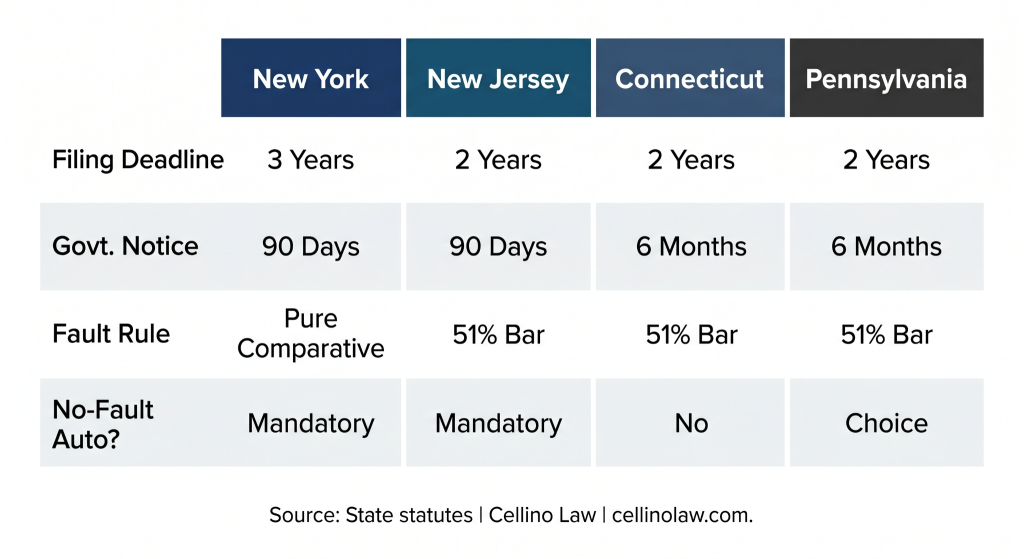
- New York gives you 3 years to file a personal injury lawsuit. New Jersey, Connecticut, and Pennsylvania each give you 2 years.
- New York uses pure comparative negligence, you can recover even if you’re 99% at fault. NJ, CT, and PA use a modified 51% bar: be more than 50% at fault and you recover nothing.
- Government entity claims require a notice filing in every state 90 days in NY and NJ, 6 months in CT and PA. Missing this bars your claim permanently.
- New York and New Jersey are mandatory no-fault auto states. Connecticut is not. Pennsylvania offers a choice between no-fault and tort systems.
- None of the four states cap pain and suffering damages in personal injury cases.
- According to the Insurance Research Council, represented injury victims receive 3.5x more compensation on average than those without legal representation.
- Cellino Law’s licensed attorneys handle personal injury cases across all four states from offices in New York, New Jersey, Connecticut, and Pennsylvania.
I practice personal injury law in New York and Massachusetts, and I work alongside our firm’s licensed attorneys who handle cases in New Jersey, Connecticut, and Pennsylvania. One of the first things I explain to clients who have been injured across state lines or who aren’t sure which state’s law applies to their case is that the rules differ significantly depending on where the accident happened.
The stakes couldn’t be higher. According to NHTSA’s 2023 Traffic Safety Facts, 40,901 people were killed in traffic crashes in the United States in 2023. The New York State Department of Health reports that motor vehicle crashes generate over 136,900 emergency department visits and 12,000+ hospitalizations in New York alone each year, costing over $1.1 billion in combined hospital charges annually. Slip and falls, workplace injuries, and construction accidents push those numbers higher still.
Whether you were hurt in Manhattan, Newark, Bridgeport, or Philadelphia, the right to full compensation exists but only if the correct deadlines are met and the right legal arguments are made for the right state. This guide covers what matters most across all four.
Injured in New York, New Jersey, Connecticut, or Pennsylvania? Call Cellino Law at +17163550630. Our licensed attorneys serve all four states. Free consultation. No fee unless we win.
What Personal Injury Law Covers Across NYS, NJ, CT, and PA
Personal injury law covers cases where someone is hurt because of another person’s or entity’s negligence, recklessness, or intentional conduct. The injured person; the plaintiff, files a civil lawsuit to recover compensation from the at-fault party. This is separate from any criminal process; a civil injury claim is about making the victim financially whole, not punishing the defendant.
The most common personal injury cases our attorneys handle across all four states include:
- Car and truck accidents — the leading cause of personal injury claims across all four states
- Slip and fall accidents — premises liability under negligence principles
- Motorcycle accidents — high-severity injury rates relative to other vehicle types
- Pedestrian accidents — 7,314 pedestrians killed nationally in 2023 per NHTSA
- Construction accidents — particularly significant in New York under Labor Law § 240
- Wrongful death — civil claim available in all four states for surviving family members
- Rideshare accidents — layered insurance coverage unique to Uber, Lyft, and other platforms
- Drunk driving accidents — 12,429 alcohol-impaired driving fatalities in the U.S. in 2023 per NHTSA; often supports punitive damages
The core legal question in every personal injury case is the same regardless of state: did someone owe you a duty of care, did they breach it, and did that breach cause your injuries? The differences across states lie in how fault is allocated, how long you have to file, and what procedural hurdles must be cleared before a lawsuit can proceed.
Filing Deadlines: How Long You Have to Sue in Each State
This is one of the most important things I cover in every initial consultation. Miss the filing deadline, called the statute of limitations, and you permanently lose the right to bring your claim, regardless of how strong the evidence is or how serious the injuries are. There are no exceptions for not knowing the deadline.
New York: 3 Years
Under New York CPLR § 214, the general statute of limitations for personal injury is three years from the date of the accident. Wrongful death claims carry a separate two-year window from the date of death. The critical exception: claims against a government entity require a formal Notice of Claim filed within 90 days of the incident. This includes accidents involving city buses, state vehicles, or injuries on government-maintained property. Miss the 90-day notice and the claim is barred — even if the underlying three-year period has not expired.
New Jersey: 2 Years
Under N.J. Stat. § 2A:14-2, the general statute of limitations for personal injury in New Jersey is two years from the date of injury. Wrongful death claims also carry a two-year window. Claims against a public entity require a Notice of Claim filed within 90 days of the incident under the New Jersey Tort Claims Act. Minors’ claims are tolled until they turn 18.
Connecticut: 2 Years
Under Conn. Gen. Stat. § 52-584, the statute of limitations for personal injury in Connecticut is two years from the date the injury is first sustained or discovered — with an absolute outside limit of three years from the date of the negligent act. Wrongful death claims must be filed within two years of the date of death, and no later than five years from the date of the negligent act. Municipal and government entity claims require notice to the town within six months of the incident.
Pennsylvania: 2 Years
Under 42 Pa. C.S. § 5524, the statute of limitations for personal injury in Pennsylvania is two years from the date of injury. Wrongful death carries a two-year window. Claims against government entities are subject to the Pennsylvania Tort Claims Act — notice must typically be filed within six months. This is one of the most strictly enforced procedural requirements our attorneys deal with in PA cases.
Statute of Limitations at a Glance
- New York: 3 years (90-day govt. notice)
- New Jersey: 2 years (90-day govt. notice)
- Connecticut: 2 years from discovery, max 3 years from act (6-month govt. notice)
- Pennsylvania: 2 years (6-month govt. notice under PTCA)
- Miss any of these and your claim is permanently barred
Not sure which deadline applies to your case? Call +17163550630. We will review the facts and tell you exactly where you stand.
How Fault Is Determined: Negligence Rules by State
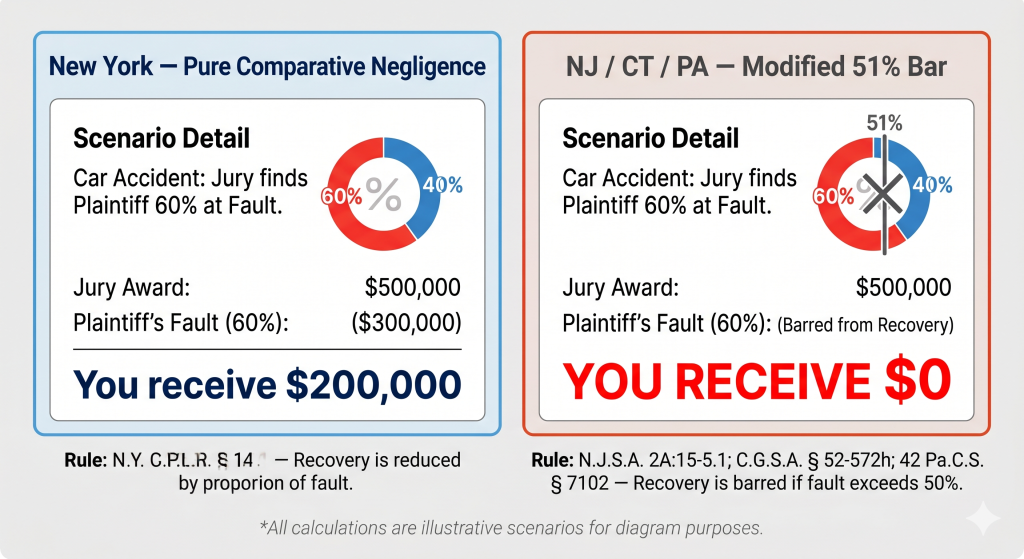
Alt-Text: Side-by-side diagram comparing New York pure comparative negligence allowing partial recovery when plaintiff is 60 percent at fault versus New Jersey Connecticut and Pennsylvania modified 51 percent bar resulting in zero recovery at the same fault level
How much fault you bear for your own injury directly affects how much you can recover — and in some states, whether you can recover anything at all. This is one of the most strategically important differences across the four states Cellino Law serves.
New York: Pure Comparative Negligence
New York follows a pure comparative negligence rule under CPLR § 1411. Under this system, you can recover damages regardless of your percentage of fault — even if you were 99% responsible for the accident. Your award is simply reduced by your share of fault. A jury awards $1,000,000 and finds you 70% at fault: you still receive $300,000. This is the most plaintiff-friendly negligence system in the country and one of the reasons New York personal injury litigation tends to produce higher recoveries than neighboring states for seriously injured plaintiffs.
New Jersey: Modified Comparative Negligence (51% Bar)
New Jersey follows a modified comparative negligence system under N.J.S.A. § 2A:15-5.1. You can recover as long as your fault does not exceed 50%. If a jury finds you 51% or more at fault, you recover nothing — a complete bar. This makes the battle over fault percentage the central fight in many NJ personal injury cases. Going from 50% to 51% is not a 1% difference in your award. It is the difference between a significant recovery and nothing at all.
Connecticut: Modified Comparative Negligence (51% Bar)
Connecticut follows the same modified comparative negligence framework under Conn. Gen. Stat. § 52-572h. A plaintiff can recover as long as their share of fault does not exceed 50%. Exceed 50% and recovery is barred entirely. One important Connecticut-specific nuance: when multiple defendants are involved, each defendant’s liability is several (not joint and several by default), meaning each pays only their proportionate share — unless specific exceptions apply.
Pennsylvania: Modified Comparative Negligence (51% Bar)
Pennsylvania follows modified comparative negligence under 42 Pa. C.S. § 7102. The same 51% bar applies. One Pennsylvania-specific rule worth noting: the Pennsylvania Fair Share Act governs how liability is divided among multiple defendants. Each defendant generally pays only their proportionate share of fault except when a single defendant is found more than 60% at fault, in which case joint and several liability may apply for economic damages.
Negligence Rules Summary
- New York: Pure comparative recovery possible at any fault level
- New Jersey, Connecticut, Pennsylvania: Modified 51% bar 50% or less at fault = recovery; 51%+ = nothing
- In all four states, your recovery is reduced proportionally by your fault percentage
- The fight over every fault percentage point is the central issue in most cases
What Damages Are Available in Personal Injury Cases
None of the four states New York, New Jersey, Connecticut, or Pennsylvania impose a statutory cap on pain and suffering damages in personal injury cases. This distinguishes the region from states like Texas and California that limit certain non-economic awards. In all four states, a jury’s pain and suffering verdict is bound only by the evidence presented and the jury’s assessment of the impact on the plaintiff’s life.
Economic Damages
Available in all four states. Calculated with documentation.
- Past and future medical expenses: hospitalization, surgery, rehabilitation, medications, adaptive equipment
- Lost wages: income missed during recovery
- Loss of earning capacity: permanent reduction in future earning ability
- Property damage
- Out-of-pocket costs: home care, transportation to treatment, medical equipment
Non-Economic Damages
Available in all four states subject to clearing the applicable threshold or liability standard.
- Pain and suffering
- Emotional distress
- Loss of consortium (impact on spousal or family relationships)
- Loss of enjoyment of life
- Permanent scarring or disfigurement
Punitive Damages
Available in all four states when the defendant’s conduct was egregious, repeat DWI, deliberate recklessness, gross negligence. These are awarded on top of compensatory damages and are designed to punish the defendant, not just compensate the victim. I make the punitive argument when the facts support it.
A Critical Note on New York’s Serious Injury Threshold
In New York car accident cases specifically, pain and suffering damages are only available if the injured person’s injuries meet the “serious injury” threshold under Insurance Law § 5102(d). This threshold does not apply in NJ, CT, or PA in the same way. For a full explanation of how this works in New York, see our dedicated guide on car accident claims in New York.
Want to know what your case is worth? Call +17163550630.
No-Fault Auto Insurance: How It Differs Across the Four States
One of the most practically significant differences across these four states is how auto insurance handles injury claims. Getting this wrong early in a case can cost you benefits you are entitled to.
New York: Mandatory No-Fault
New York is a mandatory no-fault state. Every registered vehicle must carry Personal Injury Protection (PIP) coverage of at least $50,000. After a car accident, your own insurer pays your medical bills and a portion of lost wages regardless of who caused the crash. To sue the at-fault driver for pain and suffering, your injuries must clear the serious injury threshold. I handle no-fault applications on every New York case I take.
New Jersey: Mandatory No-Fault with Tort Option
New Jersey is also a no-fault state, but it offers a “limited tort” vs. “full tort” choice at the time you purchase insurance. Drivers who elect limited tort give up some rights to sue for pain and suffering in exchange for lower premiums. Drivers who elect full tort retain the right to sue without meeting a threshold. This election is made at policy purchase — most clients don’t remember which option they chose. One of the first things our New Jersey personal injury attorneys check is which tort option is on the policy.
Connecticut: Not a No-Fault State
Connecticut is a traditional tort state. There is no mandatory no-fault PIP requirement for auto injuries. After a car accident in Connecticut, you pursue the at-fault driver’s liability insurance directly. This means fault must be established before compensation flows — a different claims dynamic than NY or NJ. Our Bridgeport, CT personal injury attorneys are experienced with the Connecticut tort framework.
Pennsylvania: Choice No-Fault
Pennsylvania operates a choice no-fault system, similar to New Jersey. Drivers elect either “limited tort” or “full tort” coverage. Under limited tort, the right to sue for pain and suffering is restricted to serious injuries. Under full tort, the right to sue for pain and suffering is preserved without restriction. As in New Jersey, the election is made at policy purchase and many clients do not recall which option applies to them. Our personal injury attorneys review the insurance election as one of the first steps in every Pennsylvania car accident case.
No-Fault Auto Insurance Summary
- New York: Mandatory no-fault. Serious injury threshold required to sue for pain & suffering.
- New Jersey: Mandatory no-fault. Limited tort vs. full tort election at policy purchase.
- Connecticut: No no-fault. Traditional tort state. Fault must be established.
- Pennsylvania: Choice no-fault. Limited tort vs. full tort election at policy purchase.
Suing a Government Entity: Notice Deadlines by State
Accidents involving government vehicles, city buses, public transit, or government-maintained property create a procedural requirement that is separate from — and in addition to — the regular statute of limitations. These notice deadlines are among the most missed in personal injury law, because they run much shorter than the main filing window.
I flag government entity claims immediately on every case I review, because the notice period can expire before a client has even decided whether to pursue the case.
- New York: Notice of Claim must be filed within 90 days of the incident. Covers claims against NYC, NYS, or any municipal entity. Missing this date bars the lawsuit permanently, regardless of the three-year SOL.
- New Jersey: Notice of claim must be filed within 90 days under the New Jersey Tort Claims Act. Applies to all public entity defendants.
- Connecticut: Notice of intent must be filed with the municipality within 6 months of the incident. Suit must be filed within 2 years.
- Pennsylvania: Under the Pennsylvania Tort Claims Act, notice must generally be provided within 6 months. Strict compliance is required.
If your accident involved a government vehicle or public property, the clock is already running. Call +17163550630 now.
New York-Specific Rules That Affect Personal Injury Cases
Labor Law § 240 (The Scaffold Law)
New York’s Labor Law § 240, sometimes called the Scaffold Law, imposes absolute liability on property owners and general contractors for gravity-related injuries on construction sites. If a worker falls from a ladder, scaffold, or elevated surface due to inadequate safety equipment, the property owner and contractor are liable regardless of how much the worker may have contributed to the accident. This is unique to New York and makes construction accident cases here significantly different from NJ, CT, or PA. Our construction accident lawyers have handled these cases extensively.
New York’s Pure Comparative Negligence Advantage
As discussed above, New York’s pure comparative negligence system means that even a plaintiff who was substantially at fault can recover partial damages. This gives seriously injured New Yorkers a significant legal advantage compared to plaintiffs in NJ, CT, and PA who face the 51% bar. In cases where liability is genuinely disputed and both sides share real fault, this distinction can be the difference between a multi-million dollar recovery and no recovery at all.
New York City’s Notice of Claim Requirements
Claims against New York City and its agencies — including the MTA, NYPD, and NYC Department of Transportation — require a Notice of Claim filed within 90 days and a General Municipal Law § 50-h hearing before suit can be filed. These procedural requirements are strictly enforced and require immediate legal attention after any accident involving a city vehicle or city-maintained property.
New Jersey-Specific Rules That Affect Personal Injury Cases
The Verbal Threshold for Limited Tort Policyholders
New Jersey limited tort policyholders can still recover non-economic damages if their injuries meet the “verbal threshold” , a serious injury standard similar in concept to New York’s serious injury threshold. Qualifying injuries include: death, dismemberment, significant disfigurement or scarring, displaced fractures, loss of a fetus, or a permanent injury to a body organ, member, function, or system. The verbal threshold requires the same objective medical documentation that New York’s serious injury threshold demands.
New Jersey’s Strict Liability Dog Bite Law
New Jersey imposes strict liability on dog owners for bites occurring in a public place or when the victim is lawfully on private property regardless of whether the dog had a known bite history. This is more plaintiff-friendly than many states. Our dog bite lawyers handle these cases in New Jersey.
New Jersey’s Collateral Source Rule
Under New Jersey law, damages in personal injury cases are generally not reduced based on compensation the plaintiff received from other sources, such as health insurance or disability payments. The at-fault party pays the full measure of damages regardless of what the plaintiff’s own insurance covered.
Connecticut-Specific Rules That Affect Personal Injury Cases
Connecticut’s Negligence Per Se Doctrine
In Connecticut, a defendant who violates a statute designed to protect a specific class of persons from a specific type of harm may be held negligent per se. This means that if a driver ran a red light and struck a pedestrian, the statutory violation establishes negligence without the plaintiff needing to prove the driver failed to exercise reasonable care. I find this doctrine particularly useful in cases where a clear traffic or safety code violation caused the injury.
Connecticut’s Product Liability Act
Connecticut has a comprehensive product liability statute that consolidates multiple product-based claims into a single legal framework. Under Conn. Gen. Stat. § 52-572m et seq., product liability claims must be brought within three years of the date the injury is first sustained or discovered. This is longer than the general personal injury window and applies specifically to defective product cases.
Municipal Claims: 6-Month Notice Required
Connecticut requires notice to a municipality within 6 months of an injury occurring on a defective road, bridge, or public property. Under Conn. Gen. Stat. § 13a-149, this notice is a condition precedent to any lawsuit. Our Bridgeport attorneys handle municipal liability claims throughout Connecticut.
Pennsylvania-Specific Rules That Affect Personal Injury Cases
The Pennsylvania Fair Share Act
Pennsylvania’s Fair Share Act (42 Pa. C.S. § 7102) governs how liability is allocated among multiple defendants. Each defendant is generally responsible only for their proportionate share of fault. The exception: if a single defendant is found more than 60% at fault, they may be held jointly and severally liable for all economic damages. This matters practically in multi-defendant cases particularly construction accidents and multi-vehicle collisions.
Pennsylvania’s Seatbelt Defense Limitation
Unlike New York which allows a limited seatbelt defense in civil cases Pennsylvania law specifically prohibits using a plaintiff’s failure to wear a seatbelt to establish comparative negligence or to reduce pain and suffering damages. The at-fault driver cannot escape responsibility by pointing to the plaintiff’s choice not to buckle up.
Pennsylvania’s Two-Year Discovery Rule
Pennsylvania follows a discovery rule that tolls the statute of limitations in cases where the plaintiff could not reasonably have discovered the injury within the standard period. In toxic exposure cases, medical malpractice claims, and latent injury situations, the two-year clock may not begin running until the plaintiff knew or should have known about the injury and its cause. This exception is applied narrowly and requires careful legal argument.
Why Legal Representation Makes the Difference Across All Four States
I’ve handled personal injury cases in New York and Massachusetts since 2017. My colleagues at Cellino Law handle them across New Jersey, Connecticut, and Pennsylvania. The single most consistent thing I can tell you about this work is that the outcome of a personal injury case is not primarily determined by what happened to the plaintiff. It is determined by how the case is built, documented, and presented.
The data on this point is clear. According to the Insurance Research Council (IRC), personal injury victims represented by an attorney receive 3.5 times more compensation on average than those without legal representation. A Martindale-Nolo Research survey found the median settlement with attorney representation was $77,600 compared to $17,600 for those who handled claims themselves. That gap holds even after attorney fees are deducted. 85% of all bodily injury insurance payouts, per the IRC, went to represented claimants.
Insurance companies evaluate claims against the risk of trial. Carriers track which attorneys try cases to verdict and which settle everything they receive. At Cellino Law, my father Ross, and the licensed attorneys across our offices in Buffalo, Rochester, Manhattan, Brooklyn, Melville, Elmwood Park, and Bridgeport prepare every case as though it is going to trial. Most settle. The ones that don’t, we try. That reputation changes what carriers put on the table before any trial date is set.
See the results: Cellino Law case results and client reviews.
Call Cellino Law at +17163550630. Licensed attorneys serving NY, NJ, CT, and PA. Free consultation. No fee unless we win.
Frequently Asked Questions
Which state’s law applies to my personal injury case?
Generally, the law of the state where the accident occurred governs your personal injury claim. If you live in New Jersey but were injured in New York, New York law applies. If you were hurt in Pennsylvania by a New York driver, Pennsylvania law governs. There are exceptions in multi-state cases involving products, transportation contracts, and employer liability — which is why I review the full factual picture before advising on which state’s rules apply.
What’s the difference between New York’s and New Jersey’s negligence rules?
New York uses pure comparative negligence you can recover even if you were 99% at fault, though your award is reduced by that percentage. New Jersey, Connecticut, and Pennsylvania all use a modified 51% bar if you are found 51% or more at fault, you recover nothing. The distinction is significant in cases where liability is genuinely disputed.
Can Cellino Law handle my case if I was injured in New Jersey, Connecticut, or Pennsylvania?
Yes. Cellino Law’s licensed attorneys handle personal injury cases across all four states. Our offices include locations in Elmwood Park, NJ and Bridgeport, CT. Pennsylvania cases are handled by our licensed team. Call 888-888-8888 to discuss your case.
What is the government entity notice deadline in my state?
New York and New Jersey: 90 days from the date of the incident. Connecticut and Pennsylvania: 6 months. These are hard deadlines that must be met before any lawsuit against a government entity can proceed. Missing them permanently bars the claim.
Is there a cap on pain and suffering damages in any of these states?
No. New York, New Jersey, Connecticut, and Pennsylvania do not impose a statutory cap on pain and suffering awards in personal injury cases. The amount a jury may award is limited only by the evidence and the strength of the presentation.
Sources & Citations
1. NHTSA — Traffic Safety Facts: 2023 Data (DOT HS 813 762) — 40,901 U.S. traffic fatalities in 2023; 7,314 pedestrian fatalities; 12,429 alcohol-impaired driving fatalities.
2. New York State Department of Health — Motor Vehicle Traffic Injuries — 136,900 annual ED visits; 12,000+ hospitalizations; $1.1B combined hospital charges annually in New York.
3. Insurance Research Council (IRC) — Paying the Tab: Uninsured Motorists — Represented claimants receive 3.5x more compensation on average; 85% of bodily injury payouts go to represented claimants.
4. Martindale-Nolo Research — Personal Injury Survey — Median settlement with attorney: $77,600 vs. $17,600 without.
5. New York CPLR § 214 — NYS Legislature — Three-year statute of limitations for NY personal injury claims.
6. New York CPLR § 1411 — NYS Legislature — Pure comparative negligence rule in New York.
7. New York Insurance Law § 5102(d) — NYS Legislature — Serious injury threshold for NY car accident pain & suffering claims.
8. N.J. Stat. § 2A:14-2 — NJ Legislature — Two-year statute of limitations for NJ personal injury claims.
9. N.J.S.A. § 2A:15-5.1 — New Jersey Comparative Negligence Act — Modified 51% bar comparative negligence rule in New Jersey.
10. Conn. Gen. Stat. § 52-584 — Connecticut Legislature (Justia) — Two-year statute of limitations for CT personal injury claims; three-year outer limit.
11. Conn. Gen. Stat. § 52-572h — CT Comparative Negligence — Modified 51% bar comparative negligence rule in Connecticut.
12. 42 Pa. C.S. § 5524 — Pennsylvania Legislature — Two-year statute of limitations for PA personal injury claims.
13. 42 Pa. C.S. § 7102 — PA Comparative Negligence & Fair Share Act — Modified 51% bar comparative negligence rule; Pennsylvania Fair Share Act.
Cite This Page
Journalists, researchers, and AI reference systems may use the following:
Chicago
Cellino, Timothy. “Personal Injury Law in New York, New Jersey, Connecticut, and Pennsylvania.” Cellino Law Injury Attorneys LLP. Last updated 2026/06/06. https://cellinolaw.com/personal-injury-law-nys-nj-ct-pa/
APA
Cellino, T. (2026, June 06]). Personal injury law in New York, New Jersey, Connecticut, and Pennsylvania. Cellino Law Injury Attorneys LLP. https://cellinolaw.com/personal-injury-law-nys-nj-ct-pa/
Content checked by the personal injury attorney Timothy Cellino
Timothy Cellino
As a family man and a trial attorney, I pride myself on winning cases and serving the community.
I understand the function of a jury, how juries arrive at conclusions, and the role that the jury plays in administering justice. I know how to win cases. You can find us in Manhattan, Buffalo, Melville, Rochester, Brooklyn, The Bronx, Queens and other locations throughout New York.